
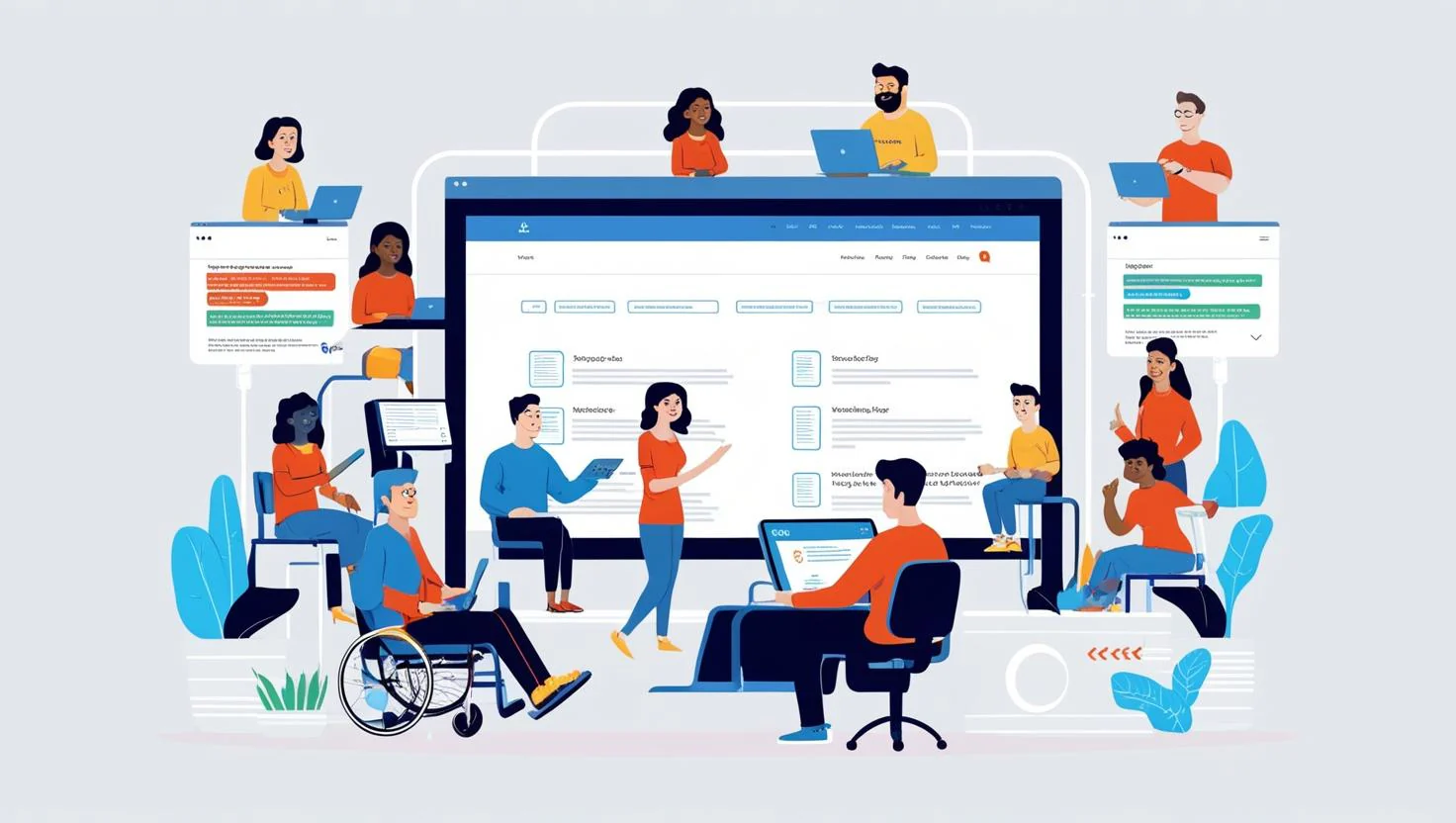
Why is web accessibility so important?
In today’s digital world, an accessible website is not an optional feature, but an essential requirement. It ensures that all users, regardless of individual restrictions, have equal access to information and services. This is not only ethically necessary, but also economically beneficial.
Advantages of an accessible website
1. Social responsibility and inclusion
There are more than one billion people with disabilities worldwide, representing around 15 percent of the world’s population. They have the same right to digital participation. Even older people or people with temporary restrictions benefit from accessible content. An inclusive design also strengthens the brand image and customer loyalty.
2. Legal requirements and legal security
Many countries have adopted web accessibility regulations, including the WCAG (Web Content Accessibility Guidelines). In Germany, BITV 2.0 applies to public sector bodies and the Accessibility Strengthening Act (BFSG), which will become mandatory for many companies from 2025. Companies that implement these requirements at an early stage reduce legal risks and at the same time improve the quality of their digital offering.
3. Extension of the target group
Accessible websites provide a better user experience for all visitors. This not only benefits people with disabilities, but also users with poor Internet connections or older people. Studies show that accessible websites have a higher dwell time and lower bounce rates.
4. Improved Search Engine Optimization (SEO)
Accessible websites are often better optimized for search engines. Clear structures, alt texts for images and semantic HTML make crawling easier and tend to lead to better rankings. A good user experience is rewarded by Google and has a positive effect on traffic and conversion rates in the long term.
5. Greater user-friendliness
A logical page structure, intuitive navigation and understandable content improve the overall user-friendliness. Well-readable fonts, clear contrasts and simple language benefit all users, not just people with disabilities.
What is digital accessibility?
Digital accessibility means that websites, apps and digital content are designed to be usable regardless of visual, hearing, motor or cognitive impairment.
Technical requirements
- Keyboard usability: All functions must be usable without a mouse.
- Screen reader compatibility: structured content, ARIA labels and semantic HTML.
- Good contrasts and scalable font sizes to ensure legibility.
- Accessible forms with clear labels, error notices and logical order.
- Alt texts for images and icons to support screen readers.
- Simple language without unnecessary jargon and long box sentences.
- Subtitles and transcripts for videos and audio.
- Structured content with clear headings, paragraphs and lists.
- Avoid automatically playing content so that users retain control over media content.
Legal requirements for accessibility

Mandatory requirements
- Public authorities must comply with BITV 2.0 and WCAG 2.1 (level AA).
- Companies are obliged by the BFSG from 2025: online shops, banks, mobility providers and other digital service providers must ensure accessibility.
No obligation, but recommended
There is no legal obligation for private websites and small companies. Nevertheless, accessibility brings advantages in usability, SEO and customer-friendliness. Early implementation can reduce later adaptation costs.
How can digital accessibility be tested?
Practical tools
- Lighthouse (Chrome DevTools): tests accessibility and performance.
- WAVE Web Accessibility Tool: identifies barriers such as missing alt texts.
- axe DevTools: Advanced developer tools for accessibility testing.
- Screen reader tests with NVDA (Windows) or VoiceOver (Mac).
- Colour Contrast Analyser: checks color combinations for sufficient contrast.
Tips for an accessible website with WordPress
WordPress as a system
The WordPress core largely meets WCAG standards. The standard theme Twenty Twenty-Four is considered accessible.
Accessible Themes
Recommended themes are GeneratePress, Astra and Neve. Important is the label “Accessibility Ready” as well as the avoidance of excessive animations and complicated menus.
Plugins for more accessibility
- WP Accessibility: detects and fixes barriers.
- Accessible Poetry: supports ARIA labels and contrasts.
- Skip To Plugin: adds a feature to jump directly to the content.
- UserWay Accessibility Plugin: improves accessibility automatically.
Website navigation without mouse

A website can only be operated via the keyboard. The most important keys at a glance:
Tab: jumps to the next interactive element (e.g. Links, buttons, form entriesShift + Tab: jumps back to the previous interactive elementEnter: activates links, buttons or other clickable elementsLeertaste: Scroll the page downShift + Leertaste: Scroll the page upPfeiltasten (↑ ↓)Scroll through the contentStrg + Pfeiltasten(Windows)Cmd + Pfeiltasten(Mac): fast scrolling
Forms and drop-down menus
Tab: jumps to the next fieldPfeiltastenNavigation in drop-down menusLeertasteorEnter: Select an option
Screen reader mode
For the use of screen readers, the following activations apply:
- Windows:
NVDA(free of charge), activatable withStrg + Alt + N - Mac:
VoiceOver, activatable withCmd + F5 - Linux:
Orca, activatable withSuper + Alt + S
Conclusion
An accessible website not only improves the user experience, but also brings advantages in SEO, reach and legal security. Especially with WordPress, there are numerous ways to make a website accessible. Those who improve accessibility increase visibility and attractiveness for all user groups in the long term. Accessibility is thus not only a legal obligation, but also an opportunity for positioning as a modern, customer-friendly company.
Further resources and legal requirements
- Detailed success criteria for accessible websites: WCAG 2.2 guidelines
- Legal requirements in Germany: Accessibility Strengthening Act (BFSG)
- Practical examples for accessible websites: Inviqa Blog
- Color analysis tool for contrasts: WebAIM Contrast Checker