
Artificial intelligence is changing society at a rapid pace and is increasingly affecting medical diagnoses, credit decisions, personnel selection and law enforcement. The central question is how much trust in AI systems is justified and what prerequisites for real trustworthiness must be met.
What does “trustworthy AI” mean?
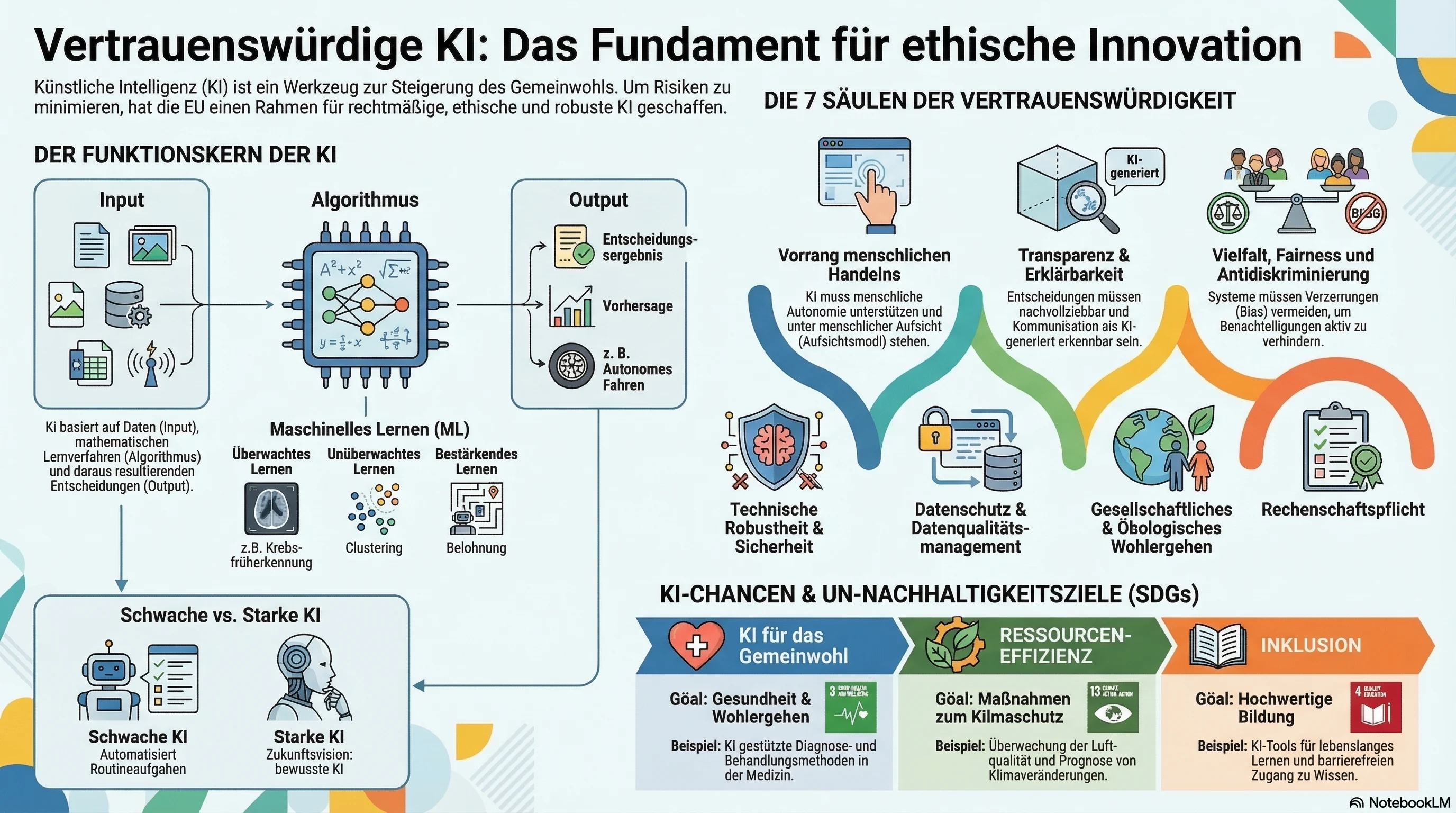
The term seems simple at first, but in the context of AI means far more than everyday trust. According to the EU Expert Group (HLEG-KI), a trustworthy AI must fulfil three core components: first, legality, i.e. compliance with European and national laws; second, ethical action in the sense of actively ensuring ethical principles; third, robustness, i.e. technical and social stability even in the event of unintended damage. Only the simultaneous fulfillment of all three components establishes real trustworthiness.
The Seven Minimum Requirements
The EU High Level Group defined seven equivalent requirements that must be met throughout the life cycle of a system:
1. Priority of human action and supervision
AI systems must not undermine human freedom of choice. Users must be able to critically question, understand and reject recommendations. Human autonomy remains paramount.
2. Technical robustness and safety
Resistance to attacks, data loss and unforeseen errors is central. Safety plans and a high degree of accuracy and reproducibility are required.
3. Data protection and data quality
Privacy, data quality and compliance with the GDPR are mandatory. Systems must not be trained on obsolete, incomplete or distorted data.
4. Transparency
Explainability is not a freestyle, but a duty. Users must be able to understand how a system works and on which database decisions are made.
5. Diversity, non-discrimination and fairness
AI must not reproduce or reinforce existing inequalities. Algorithms are particularly critical in applications, lending and police measures.
6. Social and environmental well-being
AI must serve the common good. Environmental sustainability and fundamental democratic values must be taken into account.
7. Accountability
Responsibility must be clearly attributable. Traceability, risk assessments and remedies are essential.
Why implementation is demanding
The biggest challenge lies in the definition of ethics and fairness, which are culturally and subjectively shaped. Individual fairness can contradict collective justice: Algorithms can appear fair to individuals but systematically disadvantage groups. This phenomenon is called Algorithmic Bias and has been detected by researchers in gender bias in image recognition systems.
From theory to practice: ALTAI and the AI Act
With the ALTAI (Assessment List for Trustworthy AI), the EU has created a detailed checklist for self-assessment of AI systems. The EU AI Act complements this with risk-based regulation ranging from minimal to unacceptable risk; systems such as social scoring or manipulative applications are therefore prohibited.
Conclusion
Regulations are important but do not replace continuous vigilance. Trustworthy AI requires human attention, ongoing ethical reflection and open societal debate. The question of trustworthy AI ultimately leads to a more fundamental question: What is fair? This question is not purely technical, but profoundly social.