
Introduction
Digitalization is changing almost all areas of life and presents companies of all industries with profound changes. This development is called digital transformation. Digitalized processes form the core of a modern company.
This article explains how processes are digitally recorded, analyzed and automated.
Why Processes Need to Be Digitized
Imaging processes not only on paper, but also continuously in IT systems is crucial for the company’s success today. Three main drivers can be named for this:
- Lower costs for technology: Today, computing power, storage space and Internet connections are significantly cheaper and more flexible to use, for example through cloud computing.
- Availability of large amounts of data (big data): Companies produce extensive amounts of data that can be used to precisely evaluate workflows.
- Mature software: Established technologies and standard software greatly simplify the entry into digitalization.
A digitalized process can be transparently tracked in real time, evaluated in detail and finally automated.
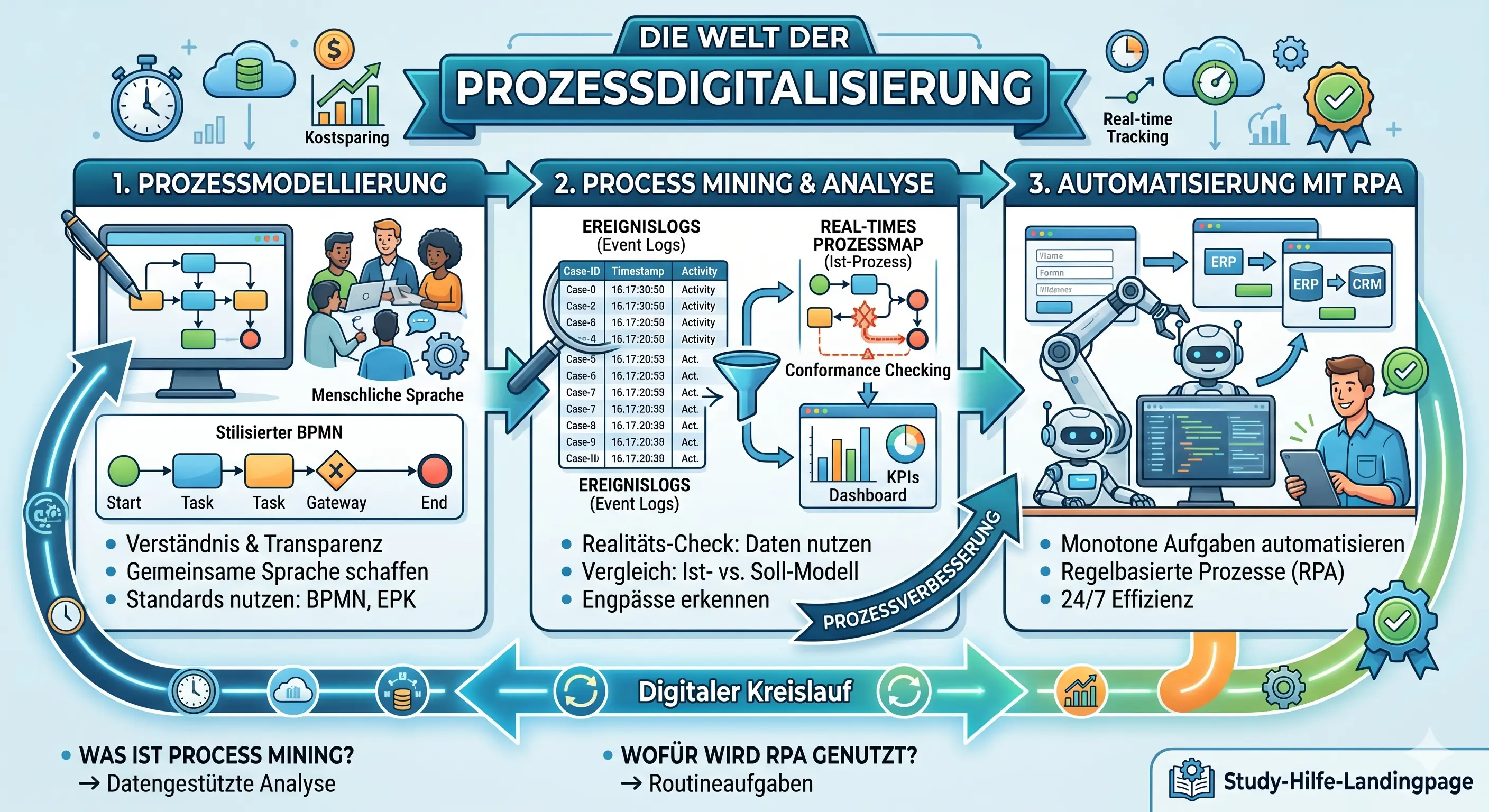
Step 1: Understand and model processes
Before a process can be improved digitally, it must be understood. This is where process modelling is used.
- Modelling serves to simplify complex realities and to map them in models.
- It creates a common language for all employees, so that the flow of a process is comprehensible for all participants.
- There are various notations to graphically represent processes, such as the Event-Driven Process Chain (EPK) or the Business Process Model and Notation (BPMN).
- With the Decision Model and Notation (DMN), complex decision rules (such as “If X occurs, then Y”) can also be displayed independently of the pure process model.
Step 2: Analyze Processes with Process Mining
The reality in everyday work often deviates from the modeled processes. This is where Process Mining comes in, a technique at the interface between data analysis (data science) and process management (process science).
- Operation: When digital processes are executed in IT systems, they leave digital traces called event logs.
- Process Discovery: From these tracks, an image of the actual process (actual state) can be automatically created, which also makes unplanned detours or bottlenecks visible.
- Conformance Checking The target model is compared with the actual data (actual state), which makes it possible to see whether rules have been violated or steps skipped.
- Process enhancement: Based on the knowledge gained, processes are specifically adapted and improved.
Step 3: Automation by Software Robots (RPA)
If a process is cleanly digitized and optimized, monotonous tasks can be transferred to software. This process is known as robotic process automation (RPA).
- RPA uses software robots that simulate human work steps.
- The robot operates the regular user interface of the IT system, for example by copying and pasting data between applications.
- RPA systems work fatigue-free, around the clock and significantly accelerate routine tasks.
- Employees are thus not superfluous, but relieved of repetitive activities and can devote themselves to creative and strategic tasks.
Importance of Process Digitalization for Marketing
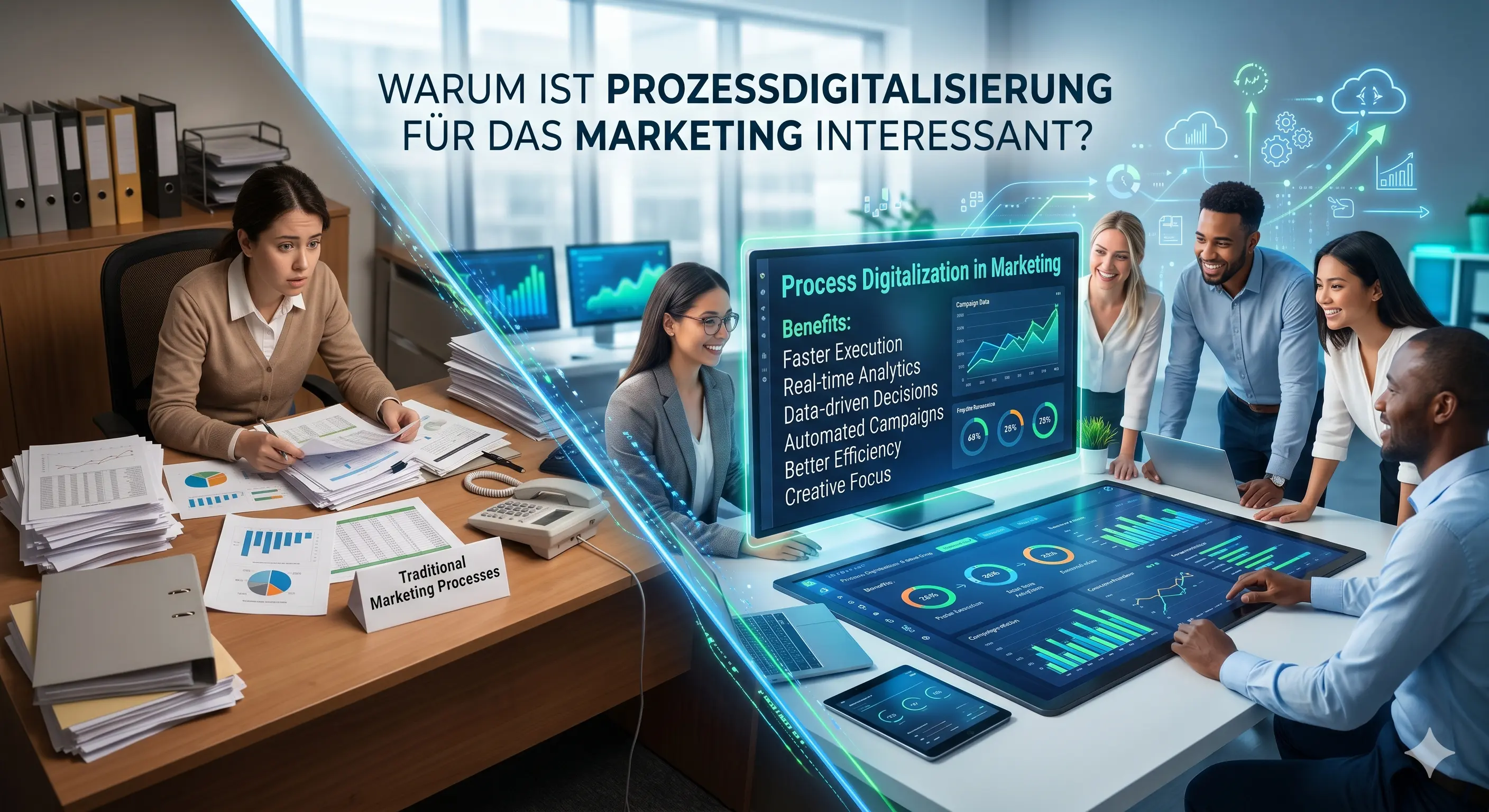
Marketing today encompasses much more than creative advertising: the focus is on the customer experience and data-driven decisions.
1. Analysis of the customer journey
Process mining is one of the most valuable approaches to understanding the customer journey.
- Real interactions in web applications can be visualized to understand actual user behavior.
- Constrictions or unnecessary loops in the process, where customers jump, can be identified.
- Event log analysis provides objective data on where the marketing funnel has vulnerabilities.
2. Meeting modern customer expectations
Digitalization has significantly changed the expectations of customers.
- Customers today expect high transparency, for example through detailed tracking of individual shipping steps in real time.
- Process digitization enables short lead times for orders, which can be an important selling point.
- Digital enablers enable companies to offer complementary digital services, for example in e-commerce.
3. Individualization and Personalization
Marketing is increasingly striving for the “segment of one”, i.e. a completely individual approach.
- Digitalized processes enable customer-specific production, for example for photo products, which is triggered automatically by the customer order.
- A manual check of the order by employees is eliminated, which makes individualization economical.
- The increasing individualization of products thus becomes an important competitive factor.
4. Efficiency through Automation (RPA)
In marketing, there are numerous repetitive tasks that bind capacities for creative strategies. Robotic Process Automation (RPA) can support:
- RPA can be used for the automated sending of bulk mail or messages.
- Software robots transfer data between different systems, such as CRM and ERP, without manual errors.
- By automating routine tasks, resources are freed up for value-adding, creative activities.
5. Use of Big Data
Marketing benefits from the growing amount of data stored worldwide.
- Data from social networks or mobile devices can be used as sources of analysis.
- Modern methods (Advanced Analytics) make it possible to identify inefficiencies from unstructured data stocks and to automate processes in a targeted manner.
Summary Process digitalization provides marketing with the technological basis to meet customer requirements more quickly, individually and transparently and at the same time to make internal processes more efficient.
FAQ on Process Digitalization
What is the difference between analogue and fully digitalized processes? In analog processes, all steps take place without IT support and leave no evaluable digital traces. Fully digitalized processes, on the other hand, are completely covered by IT systems, which enables a transparent investigation of processes.
What is an Event Log? An event log is a collection of digital tracks created when processes are executed in an IT system. For a meaningful evaluation, at least three details are required: a case ID to recognize the process, a time stamp and the name of the respective activity.
Can RPA systems also solve complex and new problems? Classic, rule-based RPA systems can only execute what has been strictly programmed in before and are not able to make complex decisions on their own. Increasingly, however, there are AI-based RPA systems (Cognitive RPA), which can read and interpret documents or react independently to screen changes.
Does a company’s IT have to be extensively reprogrammed for RPA? No. A key advantage of RPA is that the software robot works via the regular user interface of the existing programs. Expensive interfaces or interventions in existing processes are not necessary for this.
Glossary
Important technical terms:
- BPM (Business Process Management): Management approach for continuous control, control and improvement of business processes.
- BPMN (Business Process Model and Notation): standardized graphical language for representing business processes.
- Data Mining: Methods for the independent detection of structures, patterns or anomalies in large amounts of data.
- Machine learning (machine learning): Part of artificial intelligence, in which systems learn from sample data to recognize patterns and make independent decisions, for example using decision trees.
- Alpha Miner / Heuristics Miner: well-known algorithms in the field of process mining, which calculate an understandable process model from log data.
- Token Replay: mathematical method in process mining to calculate how well a process model fits the real data (the so-called fitness of the model).
- Overfitting / Underfitting: Concepts from Machine Learning. Overfitting is a model that is too rigidly adapted to known data and fails with new data. Underfitting refers to a model that is too simple to correctly represent reality.
Important personalities:
- August-Wilhelm Scheer: Scientist and entrepreneur who has significantly shaped the concept of business processes. He defined business processes as a coherent sequence of corporate tasks for the purpose of service creation.
- Wil van der Aalst: is considered one of the most influential thought leaders in the field of process mining and has written essential basic works on which modern methods of automated process analysis are based.