Many companies know the problem: There is a challenge, a meeting is scheduled and relatively quickly solutions are discussed. It was often not yet clarified whether the alleged problem is actually the problem of the customers.
This is exactly where it comes from. Design thinking an. Instead of immediately developing a solution, the method first deals intensively with the people for whom a solution should be created.
This can be particularly interesting for small and medium-sized companies. Because while large companies often have larger budgets and more staff, smaller companies can score with short decision-making processes, direct customer contact and fast tests.
What is Design Thinking?
Design Thinking is an human-centred approach to solving complex problems and developing new ideas.
This is not – as the term “design” initially suggests – mainly about design or about making something look particularly beautiful.
The focus is on a simple question:
What do the people who actually use our product, service or process need?
IDEO, one of the companies that has significantly shaped Design Thinking, focuses in particular on people and their needs.
When developing a good solution, three perspectives typically play an important role:
Desirability: Do people want or need this solution?
Feasibility: Can we implement the solution technically and organizationally?
Economic viability: Can the solution be economically viable for the company?
A good idea should connect all three areas if possible.
Design thinking is not a rigid process. The process is iterative. This means that findings can lead to a team taking one or more steps back, changing an idea and then testing it again.
Why is Design Thinking interesting for companies?
Companies often develop products and services from their own perspective.
For example, a typical question is:
“What new features could we offer our customers?”
Design Thinking changes the perspective:
“Which problem of our customers could we solve better?”
This difference seems small at first, but can have a significant impact.
| Classical approach | Design thinking |
|---|---|
| The company is developing a solution | The starting point is the problem of the user |
| Internal assumptions are often in the foreground | Users are involved early |
| Solutions are partly planned for a long time | Ideas are tested as early as possible |
| Mistakes may occur late | Weaknesses should be visible early |
| Focus on finished products | Focus on learning and improvement |
This makes Design Thinking particularly suitable for situations in which the optimal solution is not yet known.
The Six Stages of Design Thinking
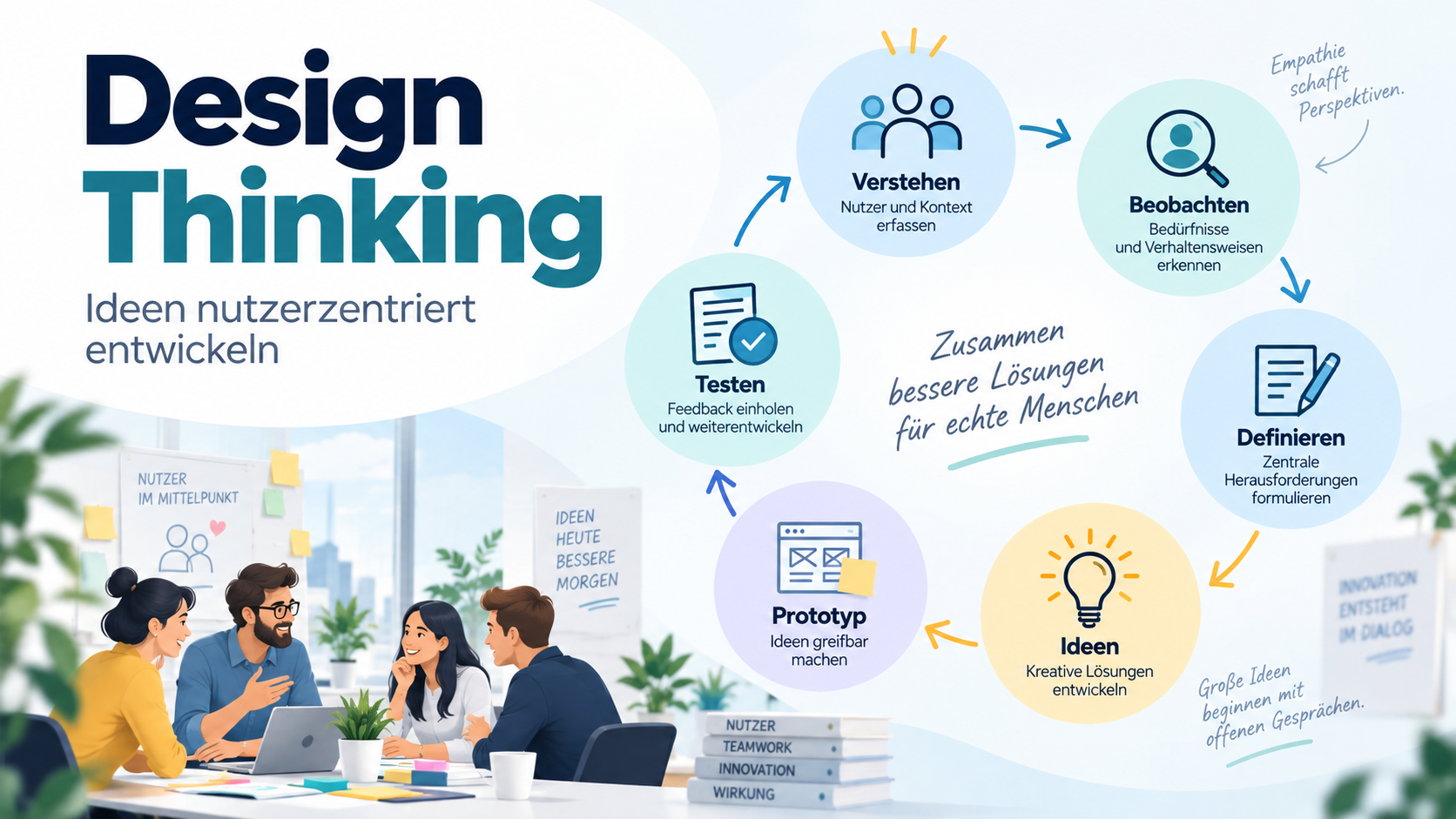
There are different variants of the design thinking process. The HPI d-school of the Hasso Plattner Institute works, for example, with a multi-stage, iterative process.
A common presentation consists of six phases:
| Phase | What happens? | Example |
|---|---|---|
| 1. Understanding | The problem and initial situation are examined. | Why do visitors stop our ordering process? |
| 2. Observation | Users are questioned or observed during use. | Conducting interviews with customers |
| 3. Defining the Viewpoint | Findings are evaluated and the actual problem is defined. | Customers do not find important product information quickly enough. |
| 4. Finding ideas | As many solutions as possible are developed. | Comparative function, consultancy, filter or product finder |
| 5. Developing a prototype | A simple version of the solution is created. | Clickable design of a new product finder |
| 6. Testing | Users test the prototype and provide feedback. | Customers try out the product finder. |
More on the approach and practical application can also be found in the HPI d-school.
It is important here: The process does not have to be passed through strictly from step one to six.
When testing, for example, it can come out that the team misunderstood the problem. Then it goes back to observation or definition of the problem.
Exactly these repetitions are part of Design Thinking.
What can I do with Design Thinking?
Design thinking can be applied to significantly more areas than just the development of new products.
Developing new products
A company wants to offer a new product. Instead of initially developing functions for months, potential customers are interviewed at an early stage.
This makes it clear, for example, that an originally planned function is hardly relevant for customers, while a completely different problem remains unresolved.
Improving services
Services can also be analyzed with Design Thinking.
For example, a craft business could investigate what problems customers experience between the first request and the actual appointment.
Perhaps the problem is not the craftsmanship, but the lack of information about when an employee appears or how long the work takes.
Optimize websites and online shops
Design thinking can also be used in online marketing.
For example, a high bounce rate on a website could initially be interpreted as a design problem.
However, conversations with users could show that visitors only cannot find certain information.
The solution might not be a complete redesign, but a better navigation or more understandable content.
Improving internal processes
Not only customers can be the focus. Employees are also users of processes and software.
Design thinking can therefore be used to improve, for example, complicated approval processes, internal software or cooperation between different departments.
Developing new digital business models
Design thinking becomes particularly interesting in digitalization.
Instead of asking:
“What technology could we use?”
The better question is first:
“Which problem could we solve better with digital technologies?”
Only then is it decided which technology is suitable for this.
How can Design Thinking help small and medium-sized businesses?
Large corporations often have advantages that a small company can hardly compensate for. They have larger marketing budgets, extensive development departments and sometimes enormous data stocks.
However, small businesses have other advantages.
Decision-making processes are often shorter. Managing directors, sales, marketing and customer service are sometimes only a few meters apart. At the same time, there is often a much more direct contact with their own customers.
This is where design thinking can play its strength.
Instead of working on a supposedly perfect solution for a year, a small team can quickly investigate a problem, develop different ideas and test a simple prototype.
The decisive competitive advantage does not necessarily arise from Spending more money, but Learn faster.
Also the HPI d-school Design Thinking emphasises the close involvement of users, interdisciplinary teams and the early testing of ideas.
Can an SME overtake larger companies?
Of course, design thinking alone does not ensure that a small company automatically becomes more successful than a large corporation.
But it can create an important advantage.
Large organizations require partial coordination between several departments, managers and hierarchical levels for changes. Small businesses can often make decisions faster.
If an SME uses this speed and at the same time consistently relies on customer feedback, new solutions can sometimes be tested and implemented faster.
The principle is therefore not:
“We have to have as many resources as a corporation.”
but:
“We need to recognize faster what our customers really need.”
Especially in times of rapid technological changes, this ability to learn can be an important competitive advantage.
A simple design thinking example from practice
Let’s imagine a medium-sized manufacturer who also sells his products through his website.
The company notes:
Many interested parties visit the product pages, but only a few make a request.
The first assumption is:
“Our prices are probably too high.”
The company could now offer discounts.
Design Thinking would initially proceed differently.
Phase 1: Understanding the problem
The company investigates analytics data, requests and conversations with sales.
Phase 2: Observe and interview customers
Some customers and prospects are asked how they use the website and what information they lack when making a purchase decision.
In this context, it can be seen, for example:
Price is not the biggest problem.
Many interested parties do not know, Which product fits your application.
Phase 3: Redefining the problem
The new question is:
“How can we help customers find the right product for their use case faster?”
Phase 4: Developing ideas
The team is developing different possibilities.
For example, a product comparison, an interactive product consultant, a new filter function or a clearly understandable presentation of the application areas would be conceivable.
Phase 5: Building a prototype
Instead of immediately programming a complex software, a simple clickable product consultant is first created.
Phase 6: Testing
Selected customers test the prototype.
The company observes where questions arise and which functions are actually helpful.
Only then is it decided whether the solution is fully developed.
The big advantage:
The company does not immediately invest a lot of time and money in an idea that no one knows if customers need it at all.
Design Thinking and Online Marketing
Design thinking can be particularly well combined with online marketing.
SEO, SEA and web analysis provide a lot of quantitative data. For example, companies can see which pages are visited, which search terms generate traffic or where users leave a process.
However, this data does not always answer the question:
Why do users behave this way?
Here, qualitative methods from Design Thinking can be a useful addition.
For example, web analysis shows:
40 percent of users leave a certain page.
A user interview can then possibly explain:
“I don’t understand at this point which product to choose.”
The combination of data analysis and direct user feedback can therefore be much more meaningful than a purely technical consideration.
Which software supports Design Thinking?
Design Thinking basically also works with paper, pens and sticky notes.
However, digital tools make collaboration easier, especially when employees work in different locations.
| Tool | Particularly suitable for | Typical application |
|---|---|---|
| Miro | Extensive design thinking projects | Personas, Customer Journeys, Brainstorming, Empathy Maps and Workshops |
| Mural | Workshops and teamwork | Design Thinking Canvas, user journeys, ideation and prototype planning |
| Figjam | Quick visual collaboration | Brainstorming, empathy maps and joint collection of ideas |
| Microsoft Whiteboard | Businesses with Microsoft 365 | Brainstorming, workshops, problem solving and collaboration |
| AI assistants | Support for individual work steps | Structuring ideas, preparing interview questions or summarizing findings |
Miro
Miro It is one of the most famous digital whiteboards. Design Thinking stands for numerous finished Design thinking templates available.
For example, Empathy Maps, Customer Journeys, Brainstormings and Workshops can be processed together.
Mural
Also included Mural is especially suitable for visual collaboration and workshops.
The company has its own Template for Design Thinking which can be used, among other things, for user research, ideation and workshops.
Figjam
Figjam is the digital whiteboard from Figma.
It is particularly suitable for teams that want to collect ideas together, visualize processes or develop initial concepts. Figma provides for this, among other things, various Brainstorming templates Ready.
Microsoft Whiteboard
Companies that already use Microsoft 365 can also Microsoft Whiteboard use.
For example, the tool can be used for workshops, idea collections and joint problem solving and is closely linked to the Microsoft environment.
What role can artificial intelligence play in design thinking?
AI can also support design thinking.
AI systems such as ChatGPT, Claude or other generative AI applications can, for example, structure large amounts of information, generate ideas, prepare interview guides or compare different solutions.
Especially in the idea phase, AI can help to develop additional perspectives.
However, it should not replace direct contact with the customer.
An AI system can suspect possible customer problems. Whether these problems actually exist, however, should be checked if possible by real users, interviews, tests or existing data.
The combination of Human understanding, data and artificial intelligence Therefore, it is likely to be more interesting in many innovation processes than the sole use of AI.
Also the HPI d-school is concerned with the further development of innovation methods and the connection of new technologies with human-centered problem solving.
Common Mistakes in Design Thinking
| Error | Better |
|---|---|
| The solution is actually fixed beforehand | Consciously leave the result open |
| Only employees are asked | Involving real users |
| Endless Brainstorming Sessions | Ideas then prioritize and test |
| Developing the perfect prototype | Start as easy as possible |
| User feedback can only be confirmed | Also seek critical feedback |
| Process once performed | Using insights for further iterations |
Design thinking therefore works less as a single creative method and more as a certain way of thinking.
FAQ – Frequent questions about Design Thinking
What is Design Thinking simply explained?
Design thinking is a method by which problems are viewed consistently from the point of view of the affected people. Teams first try to understand users and their problems, then develop ideas and test possible solutions as early as possible with simple prototypes.
Do you have to be a designer to apply design thinking?
No. Design Thinking is not exclusively aimed at designers. Teams in which different disciplines and perspectives work together are particularly useful.
For which companies is Design Thinking suitable?
The approach can be used by start-ups as well as medium-sized companies and corporations. What matters is less company size than the willingness to engage users, question assumptions and test solutions.
Is Design Thinking only suitable for new products?
No. Design thinking can be applied to products, services, websites, business models, internal processes or digital applications.
Is design thinking expensive?
Not necessarily. Especially early phases can be carried out with relatively simple means. A prototype does not have to be a finished product. Depending on the question, a drawing, a click dummy or a simple process is sufficient.
What is a prototype in Design Thinking?
A prototype is a simplified representation of a possible solution. The goal is not to create a perfect product already. The prototype should make an idea so concrete that users can understand it and give feedback.
How long does a design thinking process take?
That depends on the task at hand. A single question can be examined within a workshop, while more complex innovation projects can take several weeks or months. It is crucial to get first insights and user feedback as early as possible.
What software do I need for Design Thinking?
Special software is not mandatory. Paper, pens and sticky notes are generally sufficient. For digital or hybrid teams, for example, Miro, Mural, FigJam or Microsoft Whiteboard are suitable.
Can artificial intelligence replace design thinking?
No. AI can support research, structuring and ideation. However, the central component of Design Thinking remains the understanding of real people and their needs. Customer interviews and tests should therefore not simply be replaced by AI-generated assumptions.
Conclusion: Design Thinking means above all to learn faster
Design thinking is not a guarantee of innovation and not a silver bullet against larger competitors.
However, the approach changes the way companies view problems.
Instead of investing a lot of time and money in a supposedly perfect solution, we first try to understand the actual problem. Then ideas are made visible as early as possible and tested.
Small and medium-sized enterprises in particular can benefit from this.
They often have fewer resources than large corporations, but can decide faster, work closer to the customer and try new ideas more easily.
The crucial idea behind Design Thinking can therefore be summarized very simply:
Not build a solution as quickly as possible – but find out as quickly as possible which solution is really needed.