
An email funnel leads interested parties automated from the first registration to a desired action, for example a request, appointment booking or a purchase.
Not every contact immediately receives a sales offer. Instead, matching information is sent one after the other that explains a problem, builds trust and leads to the next meaningful step.
For example, a simple email funnel can look like this:
Website visitors → newsletter subscription → welcome mail → helpful content → appropriate performance → request
Such a funnel is particularly interesting for the self-employed and companies, because once a process has been set up, new contacts can then be accompanied largely automatically.
What do you need for an email funnel?
An email funnel consists of a few elements:
| Component | Task |
|---|---|
| Traffic source | Reaching interested parties |
| Landing or information page | Creating interest |
| Notification form | Collect e-mail address |
| Reason for registration | Newsletter, checklist, guide or other added value |
| Email series | Contact information |
| Segmentation | Differentiate interests |
| Call-to-action | Offering next step |
| Target side | Service, date or request |
| Tracking | Measure results |
What is important is the funnel not to plan from emails, but of the desired result.
The first question is therefore:
What should a contact do at the end of the funnel?
This can be, for example:
- Agree on the consultation
- Request for tender
- Buying product
- Visit the Webinar
- Booking demo
- Service requests
Only when this goal is defined should the individual e-mails be created.
Creating Email Funnel Step by Step
1. Setting the goal of the funnel
A funnel should have a concrete main goal.
An example:
An SEO consultant does not simply want to collect as many newsletter subscribers as possible.
The real objective is to:
Qualified interested parties lead to a non-binding initial interview.
All further steps can thus be oriented towards this goal.
The crucial question for every e-mail is then:
Does this message help the contact to take a meaningful step closer to the decision?
2. Creating a suitable entry
Before an email funnel can work, it needs contacts.
These can be produced, for example, by the following routes:
- SEO
- Google Ads
- Social media
- Information pages
- Specialist articles
- Webinars
- Downloads
- Events
For example, a visitor could search Google or ChatGPT for the following problem:
“Why doesn’t our website make requests?”
He ends up on an information page, already receives a helpful answer there and can then receive, for example, a further checklist:
“Website check: 15 points you should check for missing requests”
This creates a logical transition from the need for information to e-mail registration.
3. Setting up registration and consent
For newsletters and advertising e-mails, the legal framework must also be taken into account.
§ 7 UWG provides in principle for a prior express consent for advertising by electronic mail. For existing customers, there is an exception under certain conditions. The current legal regulation can be directly § 7 UWG at the Federal Ministry of Justice will be read.
In practice, the Double opt-in procedure used to confirm the registration and to document the consent given in a traceable manner.
In addition, account should be taken of, inter alia:
- understandable notification text
- Data protection declaration
- Documented consent
- Easy deregistration option
- correct sender information
The newsletter tool should technically support these processes.
4. Planning the Email Series
Now it is determined which information a new contact will receive.
For a simple funnel are often enough already four to six meaningful e-mails.
An example of a consulting service:
| Content | Objective | |
|---|---|---|
| 1 | Welcome + Promised Content | Meeting expectations |
| 2 | Explain the typical problem | Building on relevance |
| 3 | Showing solutions | Providing competence |
| 4 | Explaining errors or stumbling blocks | Strengthening confidence |
| 5 | classify their own performance | Presenting the solution |
| 6 | Offer conversation or request | Conversion |
What matters is not the number of messages.
Each email should have a traceable function within the funnel.
5. Automating emails
In order for a normal newsletter series to become an automated funnel, the email marketing system requires corresponding automation functions.
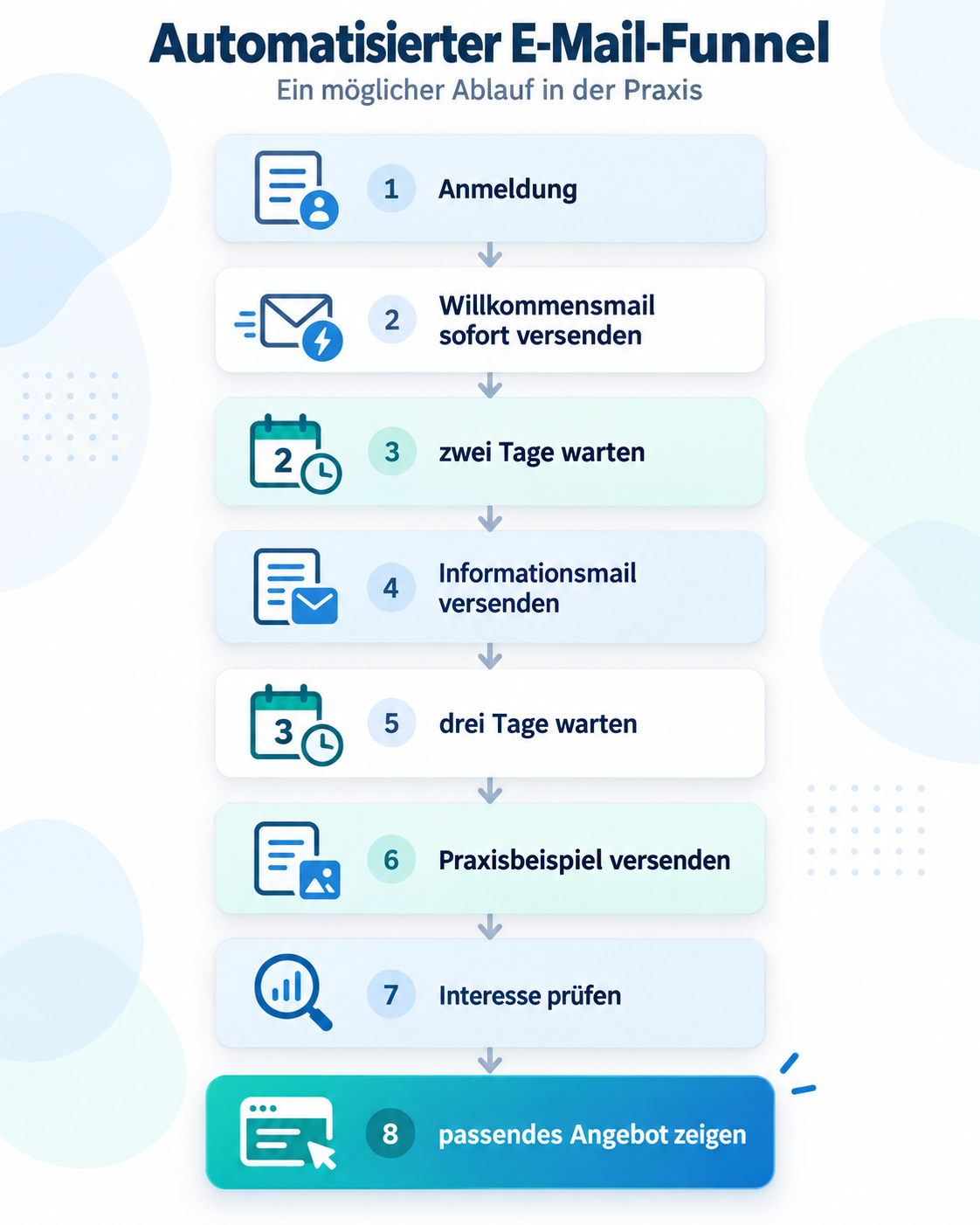
Systems such as Klick-Tipp enable such campaigns via automated email actions and conditions. For example, Klick-Tipp can check whether certain tags are present or whether contacts have clicked on certain links and control the further history accordingly.
More about the possibilities offers click tip on his page to Marketing Automation with Klick-Tipp.
Especially when several funnels or interest groups emerge later, such automations become interesting.
6. Segmenting contacts by interest
Not every contact is interested in the same topic.
An example:
A person logs in via a page on SEO.
Another about a post on Google Ads.
A third about a guide to GEO and AI Search.
Contacts could be marked accordingly:
- Interest: SEO
- Interest: SEA
- Interest: GEO
Afterwards, different e-mails or offers can be played out.
For example, Klick-Tipp works strongly with such tags. They can be awarded manually or automatically based on certain actions.
This allows a simple funnel to be gradually expanded later:
A funnel for all → segmentation → different content → more suitable offers
7. Offering a clear next step
An email funnel needs a destination.
Therefore, at some point a clear call for action should follow.
In the case of services, this can be, for example:
- Agree on initial consultation
- Analyse the website
- Request for recall
- Offer requests
- Booking date
A common mistake is to want to sell the same service immediately in every email.
Better is a logical structure:
Understanding the problem → Getting to know the solution → Building trust → Getting to know the offer → Enabling decision
The e-mails should support the contact and not artificially put under pressure.
What does a simple email funnel look like in practice?
An example of an online marketing service provider:
Starting point
A potential customer is looking for:
“Website has visitors, but no customers”
And then you get to a corresponding information page.
Notification
At the end of the article is offered:
“Free Checklist: 15 Possible Reasons for Bad Website Conversion”
The interested party enters his e-mail address and confirms the registration.
Email 1: Checklist
The promised content will be provided immediately.
In addition, there is a short hint of what follows in the next emails.
Email 2: Deepening the problem
Subject:
Why more traffic doesn’t automatically solve a bad conversion
The e-mail explains a concrete connection and links to a suitable specialist article.
Email 3: Practical solution
Subject:
The five most important areas of a website analysis
The reader receives concrete possibilities for action.
Email 4: Building Trust
An example from practice shows how typical problems can be identified and prioritized.
No result should be invented or exaggerated. Own experience and real case studies are much more credible.
Email 5: Presenting the performance
Now it can be explained:
Those who do not want to analyze the problem themselves can have a professional website analysis carried out.
The service is not suddenly advertised, but results from the previous information.
Email 6: Enable request
The last message offers a simple next step:
Settlement of non-binding initial consultation
The complete process is thus:
Search request → Information page → Download → Email series → Trust → Service page → Request
How can an email funnel be improved?
A funnel should not simply continue to run unchanged after setup.
Important key figures can be, for example:
- Number of new contacts
- Confirmation rate of notification
- Delivery rate
- Click rate
- Deregistrations
- Clicks on service pages
- Forward bookings
- Requests
- Sales
The last level is especially important.
A high open rate is interesting, but not a business goal.
More importantly,
How many relevant contacts ultimately lead to a request or other desired result?
For example, if many contacts read the emails but no one switches to the service page, the transition between information content and offer should be checked.
If, on the other hand, many people visit the service page but do not make a request, the problem could be with the service page or the offer.
Thus, the e-mail funnel is gradually optimized.
Conclusion: A good email funnel starts with the goal
An email funnel does not simply consist of several automatically sent newsletters.
It forms a comprehensible path:
Attention → Registration → Helpful Information → Trust → Appropriate Offer → Action
To get started, this process does not have to be complicated.
A simple funnel with a few high-quality emails often makes more sense than complex automation with numerous conditions, tags and branches.
Only when the basic process works, additional elements can be added:
- Segmentation
- Different interests
- Behavioural emails
- Multiple entry pages
- Different offers
- Automated follow-ups
Tools such as Klick-Tipp can technically automate these processes. However, the actual strategy remains crucial:
The right person should receive at the right time the information that is relevant for their next step.
Frequent questions about email funnels
What is an Email Funnel?
An email funnel is an automated sequence of emails that leads a contact from the first login to a defined action. This can be, for example, a request, appointment booking or a purchase.
How many emails does a funnel need?
There is no fixed number. For a simple funnel, four to six emails can already suffice. Crucially, every message serves a meaningful purpose.
How fast should emails be sent one after the other?
This depends on the topic and the target group. The first email is usually sent directly after the confirmed registration. Further messages can follow with suitable intervals. Too many messages within a short time, on the other hand, can be disturbing.
Which tool is suitable for an email funnel?
Crucial are automation functions, segmentation, registration processes and suitable integrations. For example, Klick-Tipp is geared towards tag-based marketing automation. Other newsletter systems also offer corresponding functions.
Do I need my own funnel for each lead magnet?
Not mandatory. Multiple entries can lead to the same funnel. For significantly different interests or offers, however, a segmentation or a separate funnel can be useful.
Can an email funnel also be used for services?
Yes. Especially in the case of services requiring explanation, a funnel can first convey specialist information and then lead, for example, to an initial interview or an inquiry.